Beyond the Pageantry
Next weekend Balingup will once again sprout knights, maidens, minstrels, cloaks, armour and the agreeable possibility of encountering a wizard before lunch. The Medieval Carnival allows us to play with the past, but behind all that splendid theatre lies another medieval world altogether.
To live in the Middle Ages was to live remarkably close to illness and injury. A cut hand could become a serious infection. Childbirth was dangerous. Tooth infections were life threatening. Dysentery, pneumonia, tuberculosis, leprosy, infected wounds, intestinal parasites, smallpox and recurring fevers were familiar adversaries. Then there was plague, most catastrophically the Black Death of the fourteenth century, against which Europe possessed no reliably curative medicine. People nevertheless had to do something and so they turned to whatever knowledge was available: physician, surgeon, monastery, apothecary, priest, neighbour, garden, hedgerow and herb wife. Medicine was not one road then; it was already becoming several.
The Wisdom and the Danger of Certainty
Learned medieval medicine inherited an extraordinary body of thought from Hippocrates and Galen which was further preserved, questioned and developed by Arabic and Persian scholars, most famously Avicenna. Central to it was the understanding of the four humours: blood, phlegm, yellow bile and black bile. Health was believed to depend upon their dynamic relationship within the individual and with food, season, climate, activity, rest and temperament.
The Body as a Living Whole
It would be a mistake to dismiss this simply because modern physiology describes the body differently. Beneath the old language lies an enduring proposition: human beings are not identical machines. We possess different constitutions, respond differently to our surroundings and can be pushed towards illness by excess, deficiency and imbalance.
Similar ideas continued to surface in European thought long after medieval humoral theory declined. Goethe's study of Nature sought relationship, polarity and the living whole rather than the isolated part while Rudolf Steiner later developed his own fourfold understanding of the human being and medicine. These were not continuations of Galen in any simple sense but they shared a resistance to viewing life as merely a collection of disconnected mechanisms.
When Theory Became Treatment
The danger came when an explanatory system became more certain than the body before it. If disease was attributed to an excess of blood then removing blood appeared perfectly logical. Thus venesection became commonplace alongside purging, emetics, blistering and cupping. Surgery could involve cautery with heated irons and other formidable procedures performed without modern anaesthesia or knowledge of infection. Some interventions undoubtedly saved lives, while others weakened people who were already desperately ill.
There is a lesson here that belongs to no particular century. Human beings have an astonishing capacity to accept an established treatment because respected authorities assure us it is necessary. Medieval medicine had its orthodoxies and our own age is unlikely to be immune from them. Modern medicine has given humanity extraordinary gifts, particularly in emergency care, surgery, diagnosis and infectious disease. However, it can also be intervention-heavy, over-medicalise ordinary human processes and sometimes treat a measurable symptom more readily than the conditions that produced it. Today, the medical system deserves the same useful question: does this treatment assist the organism towards health and is its benefit greater than its harm?
Returning to the Organism
Herbalism begins from a complementary premise. The body is not passive territory upon which treatment acts but a living organism continually regulating, repairing and adapting. The traditional herbalist therefore sought not only to silence a symptom but also to strengthen digestion, encourage elimination, soothe inflammation, restore sleep, nourish depleted tissues or support convalescence.
Medieval humoral medicine at its best, understood something remarkably similar. The real divide was never as simple as physician against herbalist. It arose wherever medicine moved away from observing the whole person and towards treating an idea about the illness instead.
Meanwhile, Down the Lane...
Far from the university physician was another sort of medicine. Most ordinary people could not afford to summon an eminent doctor whenever a child developed a fever or a farmer sliced his hand. Much healthcare happened at home and knowledge circulated through families, local healers, midwives, monastery infirmaries and people who knew the useful plants of their district.
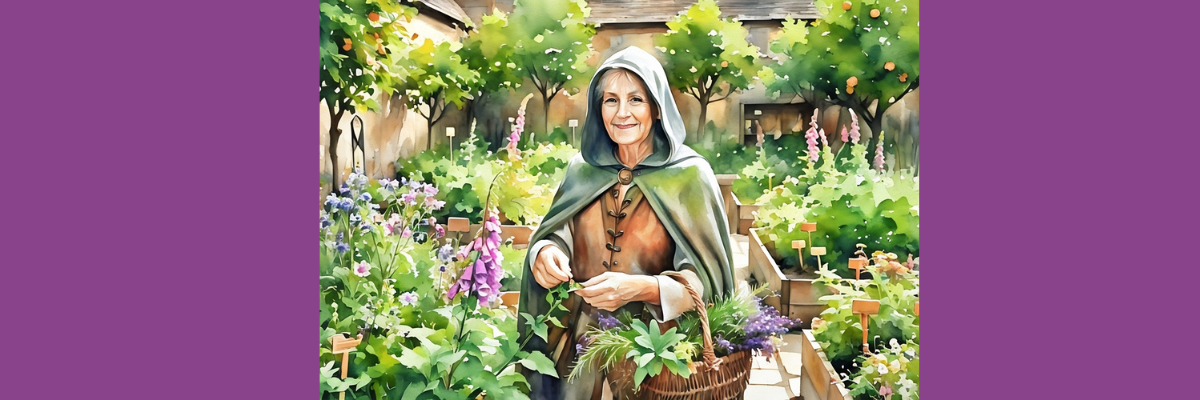
Their dispensary was growing around them. There was sage and thyme near the kitchen, yarrow in the field, plantain underfoot, elder at the boundary, nettle by the wall and willow near water. There were onions, garlic, fennel, mint and parsley which occupied that wonderful medieval territory where food and medicine were barely separate things.
This knowledge was not necessarily written down. Much of it was practical inheritance: which leaf soothed, which root purged, which plant encouraged urine, which preparation settled digestion and which poultice seemed to help an ugly wound. Medieval Welsh medical manuscripts, for example, preserve remedies containing familiar plants including garlic, mallow, parsley, vervain, yarrow and cumin. Some recipes were useless, some were decidedly hazardous, yet others contained observations worth keeping.
The Monastery as Pharmacy
Between the learned physician and the village healer stood the monastery. Monastic communities preserved medical manuscripts and cultivated plants specifically for their usefulness. Infirmary gardens contained herbs intended for the sick while gardens also supplied food, aromatic plants and materials for everyday life. English Heritage's reconstructions of medieval monastic gardens include sage, comfrey, dill, cumin, chamomile and hyssop among the plants associated with medieval physic.
The monastery garden embodies something easily forgotten about early medicine. Healing was not originally separated into today's tidy departments. Food, rest, prayer, fragrance, bathing, herbs, nursing and medicine belonged to the same landscape. The patient was still a whole person.
When Pestilence Came
Nothing tested medieval medicine more savagely than plague. When the Black Death swept through Europe from 1347, physicians and folk healers alike faced something they did not understand. Without germ theory nobody knew that Yersinia pestis was involved or understood the role played by fleas and rodents. Treatments proliferated. People were bled, purged and sweated. Aromatic herbs and flowers were carried against supposedly corrupted air. Houses were fumigated. Elaborate preparations such as "theriac" might contain scores of ingredients. Some remedies involved arsenic, mercury or substances considerably stranger than anything growing in a garden.
None cured bubonic plague and that distinction matters. One of the few genuinely useful public-health responses was separation of the sick from the well. The practice eventually developed into formal quarantine, our very word deriving from the later forty-day isolation period. Herbs would still have had another role. They could soothe pain, settle digestion, dress wounds, provide nourishment, freshen foul surroundings and make an ill person more comfortable. That is different from curing plague and the distinction makes the history more credible rather than less.
Some Old Remedies Refused to Die
The most fascinating medieval remedies are not those we can romanticise but those that eventually made science turn around and look again. Willow bark is a beautiful example. Preparations of willow had been used for pain and fever since antiquity and remained in medicinal use through the Middle Ages. We now know that willow contains salicin and related compounds. The long investigation of these natural salicylates eventually contributed to the development of acetylsalicylic acid, better known as aspirin. Willow bark and aspirin are certainly not identical medicines, but there is an unmistakable botanical ancestry.
Honey provides another remarkable bridge between worlds. Long valued for dressing wounds, honey is no longer merely a quaint folk remedy. Modern research has demonstrated potent antimicrobial properties and organic raw honey now has recognised applications in wound care.
And then there is garlic.
A thousand-year-old Anglo-Saxon eye remedy recorded in Bald's Leech book combined garlic with another Allium, wine and ox gall. When researchers reconstructed the formula and tested it against modern bacteria they found surprisingly strong activity against Staphylococcus aureus, including antibiotic-resistant strains. Intriguingly the effect appeared to depend upon the combination rather than simply one heroic ingredient. The medieval maker could not have spoken of bacterial biofilms, phytochemicals or antimicrobial mechanisms, but observation sometimes arrived centuries before explanation.
Two Ways of Seeing the Body
Across the centuries medicine became increasingly skilled at separating things in order to understand them: organ from organism, compound from plant, pathogen from patient and eventually molecule from cell. This reductionist method has produced astonishing knowledge. It allows us to identify a bacterium, repair an artery, replace a joint and understand biochemical pathways that a medieval healer could never have imagined. Yet reduction is a method of investigation, not a complete philosophy of health, a human being eventually has to be put back together.
Herbal medicine has generally retained that wider field of vision. A medicinal plant is itself chemically complex and traditional prescribing considers the person using it: digestion, sleep, appetite, circulation, elimination, resilience, constitution and the circumstances surrounding illness. Instead of asking only, “What will stop this symptom?” it may also ask, “Why has the organism arrived here and what might help it regain its own capacity for balance?”
There is no need to make enemies of these approaches. Both descend from humanity's ancient attempt to understand suffering and restore health. Modern medicine has become extraordinarily accomplished at intervention. Herbalism preserves an equally valuable emphasis on participation: nourishing, strengthening, regulating and working with the body's inherent tendency towards repair. There is an economic thread here too. As medicine became increasingly entwined with the pharmaceutical industry, research naturally favoured substances that could be standardised, manufactured and protected by patents. Familiar medicinal plants offered less commercial incentive, which helps explain why some traditional remedies received less formal investigation despite centuries of use.
Perhaps the most useful medicine of the future will be less interested in defending territories and more interested in knowing which way of seeing is needed at a particular moment.
The Green People
Perhaps the most appealing figure in this history is not the physician in his robes at all but the largely unnamed keeper of practical plant knowledge. Every community had people who knew more than others about the surrounding vegetation. They knew when elderflower appeared, where the best nettles grew, how to dry mint without ruining it and which roots were worth digging. Some were midwives, some were monastics, some were apothecaries or professional healers and many were simply householders whose knowledge had travelled through generations.
We sometimes call them the cunning folk, wise women, herb wives or green people although medieval reality was far less neatly labelled. They did something profoundly important. They kept medicinal knowledge close to ordinary life. The medicine did not always arrive on horseback carrying a leather bag. Sometimes it was growing beside the door.
Wisdom Needs Discernment
None of this requires us to romanticise the past. Medieval herbal practice contained inspired observation alongside superstition, mistaken diagnosis and remedies that could be ineffective or dangerous. Potent plants such as henbane, mandrake and monkshood demanded knowledge and dosage mattered enormously. Preparations varied in strength and healers had no laboratory analysis with which to identify an infection or determine precisely what their medicines contained. But nor should we assume that being modern automatically protects us from error. Every era develops treatments that later generations modify, abandon or wonder how anyone accepted. Progress depends upon retaining what proves valuable and having the courage to question what does not.
This is perhaps where the herbal tradition has shown remarkable endurance. Plants were not preserved in medicine merely because they were old. Many remained because generation after generation found them useful. Modern phytochemistry has since explained some of those observations while others remain matters of traditional practice rather than established clinical fact. The old knowledge deserves neither blind belief nor casual dismissal. It deserves curiosity, evidence and discernment.
The Garden Still Knows Something
This is where our medieval story unexpectedly arrives back in Balingup. We now possess things a medieval villager could scarcely have imagined: sterile surgery, antibiotics, diagnostic imaging, intensive care, anaesthesia and emergency medicine. Few sensible people would surrender those achievements for a fourteenth-century infirmary. But perhaps we surrendered a few useful things along the way, particularly the understanding that health is something cultivated throughout ordinary life rather than repaired only when it breaks down.
Earlier traditions placed considerable value on nourishing food, sound sleep, good digestion and the intelligent use of plants, with daily habits forming part of medicine itself. Caring for the body before illness takes hold is hardly an antiquated idea. Nor is our dependence upon the plant kingdom, with which human beings have been in an intimate biochemical relationship since long before anyone thought to give that relationship a medical name.
The medieval herbalist had no knowledge of flavonoids, salicylates, volatile oils, tannins or antimicrobial phytochemicals, yet generations of practical observation had taught people which plants were worth reaching for. Willow was valued for easing pain, honey found its place in the treatment of wounds and fennel was familiar after a heavy meal, while aromatic herbs brought freshness and comfort to the sickroom and helped disperse foul odours. They may not have understood the mechanisms involved, but useful knowledge did not depend upon having the language to explain it. Sometimes observation came first and understanding followed centuries later.
Come Hither to Balingup
So when Balingup fills with banners, armour and medieval revelry next weekend we can enjoy the theatre wholeheartedly. Thank goodness the bloodletting bowl, cautery iron and plague cart belong to history. But spare a thought for the herb garden. Among all the grand characters of the medieval world it may have been one of the most faithful. It fed people, seasoned their meals, scented their homes, comforted their sick and supplied remedies when little else was available.
The clothes have changed, the science has advanced considerably and the old theories have been challenged and discarded. Yet rosemary still grows, sage still scents the hand that brushes it. Garlic still releases its fierce chemistry when crushed. Willow still carries salicylates beneath its bark and honey remains far more biologically interesting than its sweetness suggests. Some medieval things are best enjoyed for one weekend a year. The herb garden is worth keeping.